
Last week,
Burning Man took place--an event touted for being a whole week of such sensory-overwhelming, semi-anarchistic, "creative chaos," that its 40-50,000 participants need several days of cultural decompression to integrate back into mainstream society. And yet the overhead photo of the event, at a makeshift town called Black Rock City in Northern Nevada that is constructed and disassembled just for the week, shows that they create subcultures that cluster and satellite around the giant wooden "burning man" effigy in a rather orderly manner.
Christine's post discusses the chaos of learning. As we've established, there is no one set way to teach and learn. But chaos brings about order in many ways, such as the way Burning Man does.

In academia, the Chaos theory of natural science and mathematics can create geometric orders in fractal graphics, even in nature, such as the dimensions of a leaf. In the humanities, the Formalist literary criticism of New Criticism claims "good poetry" to be a harmonising of chaotic elements in the poem. Specifically in education, even Wiggins and McTighe, in
Understanding by Design, warn "[not to] confuse the logic of the final product with the messy process of design work" (29). As long as we can identify the order, then, embracing a chaotic/improvisational pedagogy may not only be fine, but perhaps even desirable as a method of breaking outdated but persistent traditional pedagogy.
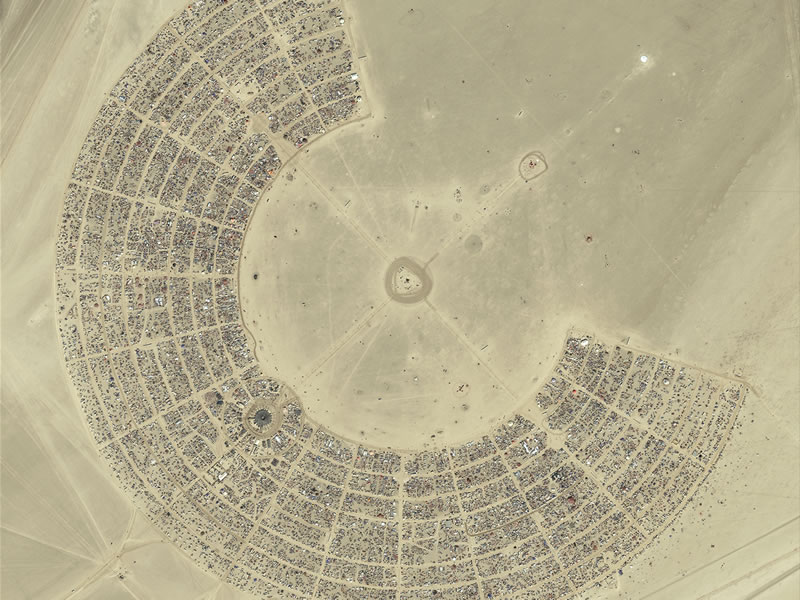 Last week, Burning Man took place--an event touted for being a whole week of such sensory-overwhelming, semi-anarchistic, "creative chaos," that its 40-50,000 participants need several days of cultural decompression to integrate back into mainstream society. And yet the overhead photo of the event, at a makeshift town called Black Rock City in Northern Nevada that is constructed and disassembled just for the week, shows that they create subcultures that cluster and satellite around the giant wooden "burning man" effigy in a rather orderly manner. Christine's post discusses the chaos of learning. As we've established, there is no one set way to teach and learn. But chaos brings about order in many ways, such as the way Burning Man does.
 In academia, the Chaos theory of natural science and mathematics can create geometric orders in fractal graphics, even in nature, such as the dimensions of a leaf. In the humanities, the Formalist literary criticism of New Criticism claims "good poetry" to be a harmonising of chaotic elements in the poem. Specifically in education, even Wiggins and McTighe, in Understanding by Design, warn "[not to] confuse the logic of the final product with the messy process of design work" (29). As long as we can identify the order, then, embracing a chaotic/improvisational pedagogy may not only be fine, but perhaps even desirable as a method of breaking outdated but persistent traditional pedagogy.


Very interesting . . although theorists of "emergent" behavior usually stipulate that a few simple rules and massive participation are enough to generate order and meaning (i.e. the "hive" metaphor) . . . chaos can be good . . but especially good if it leads to some kind of (arbitrary, contingent, etc.) order . . .I think.
ReplyDelete